2026
Brain2Vec - A Self-Supervised 3D Foundation Model for Structural Brain MRI
Spiros Maggioros, Guray Erus, Gareth Harman, George Aidinis, Pratik Chaudhari, Aristeidis Sotiras, Christos Davatzikos
ArXiv 2026
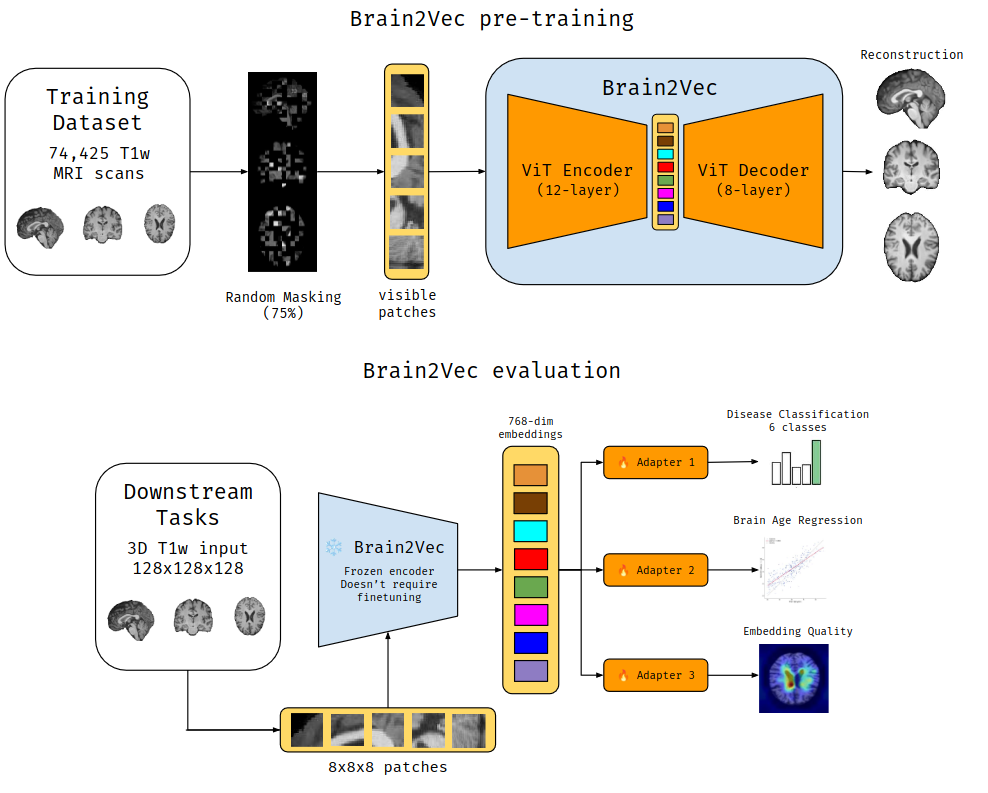
Deep learning models have become essential tools in medical imaging, yet training them end-to-end for diverse tasks remains challenging due to limited labeled data and computational constraints. To address this, we introduce Brain2Vec, a foundation model pre-trained on 74,425 T1-weighted MRI scans pooled from multiple studies within the iSTAGING consortium. Brain2Vec can serve both as a weight initialization backbone for fine-tuning downstream tasks and as a standalone feature extractor. We evaluate Brain2Vec across three dimensions - downstream predictive performance, convergence speed, and embedding quality. Using Brain2Vec’s pretrained weights as initialization and fine-tuning on labeled data for a brain age prediction task, results demonstrate improved final accuracy and faster convergence compared to random initialization. Additionally, its frozen embeddings outperform anatomically defined volumetric features on four of five downstream classification tasks and perform competitively with a state-of-the-art foundation model pre-trained on substantially more data. Lastly, we show that Brain2Vec encodes information primarily from a spatially localized and neuroanatomically meaningful set of brain regions, and that manipulating a subset of latent features produces monotonic, region-specific effects on the reconstructed anatomy. Brain2Vec code and trained models are available as an open-source package on https://github.com/CBICA/Brain2Vec. Users can apply Brain2Vec locally by installing the package, or directly through the NiChart cloud platform https://cloud.neuroimagingchart.com, where Brain2Vec features can be derived without requiring local installation or specialized infrastructure.
Brain2Vec - A Self-Supervised 3D Foundation Model for Structural Brain MRI
Spiros Maggioros, Guray Erus, Gareth Harman, George Aidinis, Pratik Chaudhari, Aristeidis Sotiras, Christos Davatzikos
ArXiv 2026
Deep learning models have become essential tools in medical imaging, yet training them end-to-end for diverse tasks remains challenging due to limited labeled data and computational constraints. To address this, we introduce Brain2Vec, a foundation model pre-trained on 74,425 T1-weighted MRI scans pooled from multiple studies within the iSTAGING consortium. Brain2Vec can serve both as a weight initialization backbone for fine-tuning downstream tasks and as a standalone feature extractor. We evaluate Brain2Vec across three dimensions - downstream predictive performance, convergence speed, and embedding quality. Using Brain2Vec’s pretrained weights as initialization and fine-tuning on labeled data for a brain age prediction task, results demonstrate improved final accuracy and faster convergence compared to random initialization. Additionally, its frozen embeddings outperform anatomically defined volumetric features on four of five downstream classification tasks and perform competitively with a state-of-the-art foundation model pre-trained on substantially more data. Lastly, we show that Brain2Vec encodes information primarily from a spatially localized and neuroanatomically meaningful set of brain regions, and that manipulating a subset of latent features produces monotonic, region-specific effects on the reconstructed anatomy. Brain2Vec code and trained models are available as an open-source package on https://github.com/CBICA/Brain2Vec. Users can apply Brain2Vec locally by installing the package, or directly through the NiChart cloud platform https://cloud.neuroimagingchart.com, where Brain2Vec features can be derived without requiring local installation or specialized infrastructure.