
CBICA, University of Pennsylvania
I'm Spiros Maggioros, a Machine Learning Researcher at CBICA, Penn Medicine and also a final year undergraduate student of electrical & computer engineering at NTUA. I spend most of my time implementing and training 3D Deep Learning models for brain imaging. I'm also interested in generic machine learning/computer vision algorithms and optimization, contributing to many open source projects over the years.
The last two years i'm part of NiChart, a cloud-based application for neuroimaging research that provide wide access to many tools that we develop in CBICA. The NiChart project is supported, in part, by NIH grants U24NS130411 and RF1AG054409 and the cloud implementation is also supported by Amazon Web Services (AWS). On NiChart, you can find all of my models including Brain2Vec, DeepSPARE-BA and all derived models.
Warning
Problem: The current name of your GitHub Pages repository ("Solution: Please consider renaming the repository to "
http://".
However, if the current repository name is intended, you can ignore this message by removing "{% include widgets/debug_repo_name.html %}" in index.html.
Action required
Problem: The current root path of this site is "baseurl ("_config.yml.
Solution: Please set the
baseurl in _config.yml to "Education
-
 National Technical University of AthensDepartment of Electrical & Computer Engineering
Undergraduate, Integrated MastersSep. 2021 - Feb. 2027
Experience
-
 University of Pennsylvania - CBICAMachine Learning ResearcherJul. 2024 - Present
 -
 O.T.E - Hellenic TelekomMachine Learning - InternshipJul. 2023 - Aug. 2023
Honors & Awards
-
Silver Medalist X2 GRCPC (GReek Collegiate Programming Contest)2024-2026
-
Cosmote Scholarship2021
News
Selected Publications (view all )
Brain2Vec - A Self-Supervised 3D Foundation Model for Structural Brain MRI
Spiros Maggioros, Guray Erus, Gareth Harman, George Aidinis, Pratik Chaudhari, Aristeidis Sotiras, Christos Davatzikos
ArXiv 2026
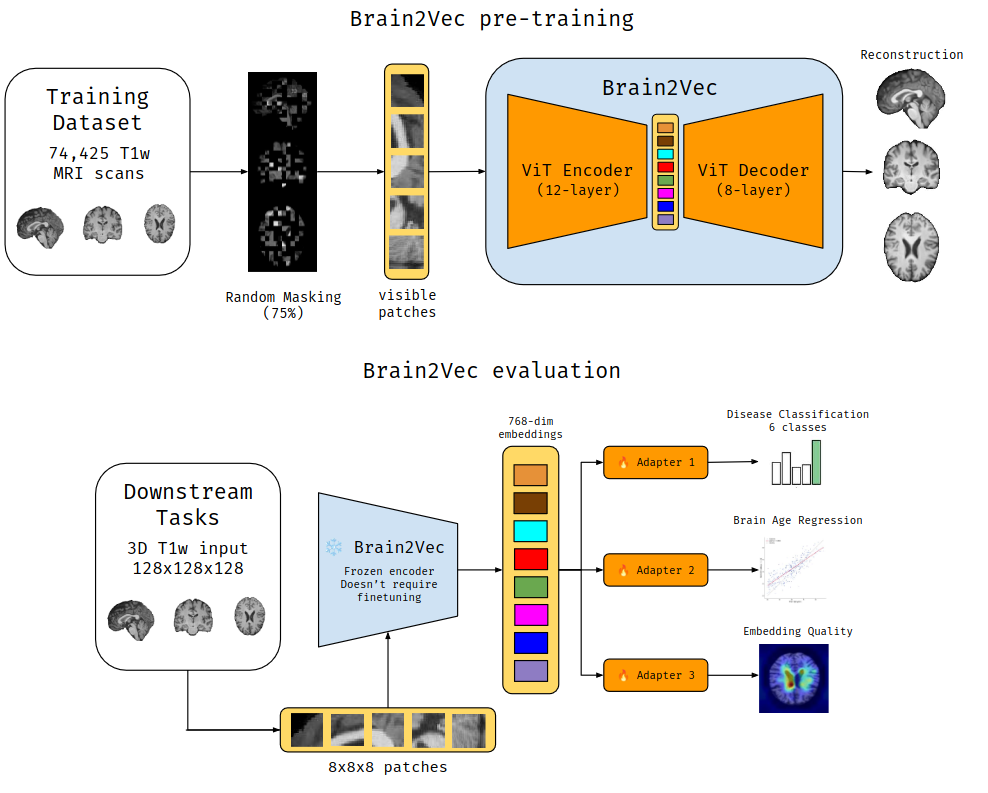
Deep learning models have become essential tools in medical imaging, yet training them end-to-end for diverse tasks remains challenging due to limited labeled data and computational constraints. To address this, we introduce Brain2Vec, a foundation model pre-trained on 74,425 T1-weighted MRI scans pooled from multiple studies within the iSTAGING consortium. Brain2Vec can serve both as a weight initialization backbone for fine-tuning downstream tasks and as a standalone feature extractor. We evaluate Brain2Vec across three dimensions - downstream predictive performance, convergence speed, and embedding quality. Using Brain2Vec’s pretrained weights as initialization and fine-tuning on labeled data for a brain age prediction task, results demonstrate improved final accuracy and faster convergence compared to random initialization. Additionally, its frozen embeddings outperform anatomically defined volumetric features on four of five downstream classification tasks and perform competitively with a state-of-the-art foundation model pre-trained on substantially more data. Lastly, we show that Brain2Vec encodes information primarily from a spatially localized and neuroanatomically meaningful set of brain regions, and that manipulating a subset of latent features produces monotonic, region-specific effects on the reconstructed anatomy. Brain2Vec code and trained models are available as an open-source package on https://github.com/CBICA/Brain2Vec. Users can apply Brain2Vec locally by installing the package, or directly through the NiChart cloud platform https://cloud.neuroimagingchart.com, where Brain2Vec features can be derived without requiring local installation or specialized infrastructure.
Brain2Vec - A Self-Supervised 3D Foundation Model for Structural Brain MRI
Spiros Maggioros, Guray Erus, Gareth Harman, George Aidinis, Pratik Chaudhari, Aristeidis Sotiras, Christos Davatzikos
ArXiv 2026
Deep learning models have become essential tools in medical imaging, yet training them end-to-end for diverse tasks remains challenging due to limited labeled data and computational constraints. To address this, we introduce Brain2Vec, a foundation model pre-trained on 74,425 T1-weighted MRI scans pooled from multiple studies within the iSTAGING consortium. Brain2Vec can serve both as a weight initialization backbone for fine-tuning downstream tasks and as a standalone feature extractor. We evaluate Brain2Vec across three dimensions - downstream predictive performance, convergence speed, and embedding quality. Using Brain2Vec’s pretrained weights as initialization and fine-tuning on labeled data for a brain age prediction task, results demonstrate improved final accuracy and faster convergence compared to random initialization. Additionally, its frozen embeddings outperform anatomically defined volumetric features on four of five downstream classification tasks and perform competitively with a state-of-the-art foundation model pre-trained on substantially more data. Lastly, we show that Brain2Vec encodes information primarily from a spatially localized and neuroanatomically meaningful set of brain regions, and that manipulating a subset of latent features produces monotonic, region-specific effects on the reconstructed anatomy. Brain2Vec code and trained models are available as an open-source package on https://github.com/CBICA/Brain2Vec. Users can apply Brain2Vec locally by installing the package, or directly through the NiChart cloud platform https://cloud.neuroimagingchart.com, where Brain2Vec features can be derived without requiring local installation or specialized infrastructure.